

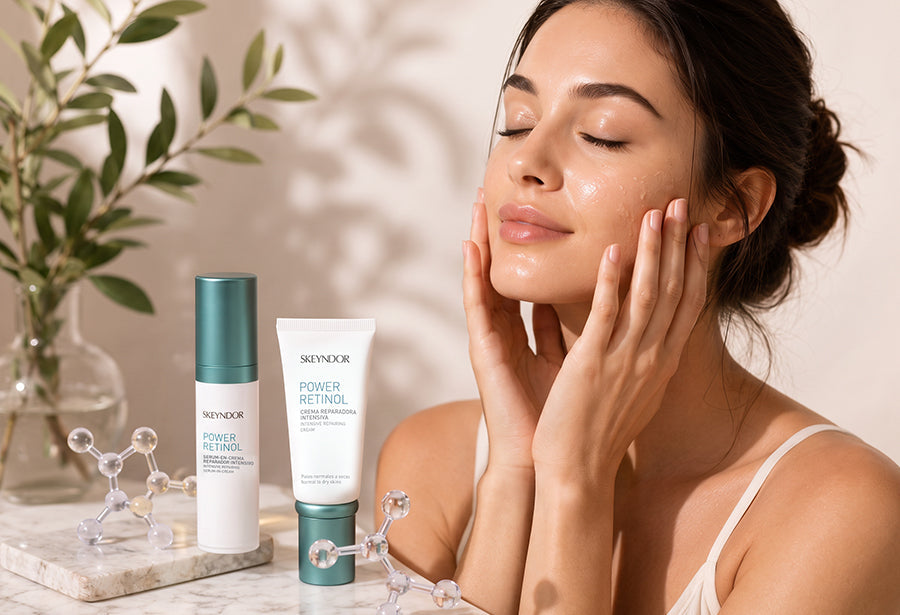
Today, Vitamin A skincare goes beyond retinol. Actives like retinal and retinaldehyde are also making their way into advanced skincare formulations.
But what really sets retinal apart from retinol? Is retinal simply an upgraded form of retinol, or does it offer something fundamentally different for the skin?
It's a fair question, because the marketing around retinal makes it sound like the upgraded version — stronger, faster, better. That's... mostly true, but not for the reason most brands say it is.
Retinol and retinal are both forms of Vitamin A. But neither is active in the exact form you apply to your skin. Your skin needs to convert them first.
Retinol requires two conversion steps to become active, while retinal requires just one.
That's it. Chemically speaking, that's the key difference. And it's this difference that explains why the two ingredients can behave differently on your skin.
Now, let's look at what that actually means for your skin.
What Is Retinol, Exactly?
Retinol has been a part of skincare for a long time, especially by skincare standards. Retinol is a form of Vitamin A, and it's the ingredient most people mean when they say, "I started using retinol." And just as often, you'll hear: "I tried retinol once, and my skin completely freaked out."
What many people don't realize is that retinol isn't active on its own. Once it reaches the skin, it has to go through a conversion process.
First, it converts into retinaldehyde — yes, the same molecule as retinal, which we'll come to in a moment. Then, it converts into retinoic acid, the active form that your skin actually responds to.
That means retinol requires two conversion steps before it becomes active.
And with each step, a little potency is lost. Interestingly, that can work in retinol's favour, because the effect is more gradual and generally easier to tolerate as your skin builds up a tolerance.
That's really why retinol has remained a go-to starting point in skincare. It's relatively forgiving and easier to introduce gradually.
If you're new to actives, or your skin tends to react when you introduce new ingredients too quickly, retinol can be a good place to start. You can explore our Power Retinol range to find where to begin.
What Is Retinal (Retinaldehyde)?
Retinal, or retinaldehyde, is essentially the same thing, and it sits one step closer to the active form than retinol does. Your skin only needs to convert retinal once into retinoic acid, rather than twice.
It may sound like a small technical detail, but it can make a meaningful difference in practice. With fewer conversion steps, more of the retinal you apply can reach its active form, which means results may appear sooner.
Research also suggests that retinal may offer antimicrobial benefits that aren't as evident with retinol. Depending on your skin and concerns, that can be an added benefit.
And one important point: retinal isn't a new ingredient. It has been studied for decades. It has simply taken time to become more common in consumer skincare because retinal is genuinely more difficult and expensive to stabilize in a formula without it breaking down.
Retinal vs Retinol: The Real Difference
Vitamin A needs to become retinoic acid to meaningfully support cell turnover, collagen, and pigmentation. Retinol starts two steps away from that active form. Retinal starts just one step away. And prescription tretinoin? It's already in the active form, so no conversion is needed.
That one-step difference between retinal and retinol explains most of the differences we talk about:
Speed: Retinal can show visible changes within a few weeks, while retinol usually takes a couple of months before noticeable results appear.
Strength: A lower concentration of retinal, such as 0.1%, can deliver effects comparable to a much higher concentration of retinol. So formulations can use less of the ingredient.
Irritation: And this is where it gets interesting. You might expect the stronger ingredient to be harsher, but retinal is often reported to be better tolerated than its potency would suggest. That doesn't mean it's irritation-proof, just that it may be gentler than you'd expect on paper.
Price & Availability: Retinol is easier and more affordable to formulate, and it has decades of consumer trust behind it. That's why it's everywhere. Retinal is less common and usually comes at a higher price.
None of this makes one "fake" or the other "better" in absolute terms. They're both working toward the same goal.
Which One Should You Pick?
Honestly, this is less about which ingredient wins on paper and more about where your skin is right now.
If you're new to retinoids, or your skin tends to react when you introduce new products, retinol is a good place to start. There's a much wider range of strengths available, so you can start low and gradually work your way up without having to guess.
If you've been using retinol for a while and feel like it's not making as much of a difference anymore, basically hitting a plateau, retinal can be a reasonable next step.
It can also be a good middle ground if retinol felt too slow, but a prescription retinoid felt like too much, too fast.
If your skin is reactive, compromised, or dealing with rosacea, honestly, we would skip both for now.
Focus on repairing your skin barrier first. Our guide on how to repair your skin barrier is a good place to start. Getting your exfoliation routine under control also helps — the Probiome Peel range or a mandelic-acid based cleanser like the Pure Cleansing Foam can be a milder way to support exfoliation without overwhelming your skin before you introduce a retinoid.
How to Introduce Either One Into Your Routine?
The mistakes people make with retinal and retinol are almost the same, so a few basic rules apply whichever one you choose.
Start slow. Begin with two or three nights a week, not every night. Your skin needs time to adjust before you increase the frequency, and going too fast is one of the biggest reasons people give up on retinoids altogether.
Nighttime only. Both ingredients can break down when exposed to sunlight, so using them during the day can reduce their effectiveness and increase the chance of irritation.
SPF the next morning, without exception. When using retinoids, sunscreen becomes even more important, so make our SPF range a non-negotiable part of your morning routine.
Pair it with hydration, not another active. A rich cream underneath or over your retinoid can give your skin an extra buffer while it adjusts.
Keep strong acids for a separate night. Using AHAs or BHAs with a retinoid in the same routine can be too much for your skin, especially when you're just starting out. Give your skin some space until it can comfortably tolerate both.
And if managing multiple products feels complicated, a cream formulated with Vitamin A derivatives and barrier-supporting ingredients can make that balancing act much easier. Our Intensive Repairing Cream is designed for exactly that, combining targeted actives with the hydration your skin needs to better tolerate them.
How Long Until You Actually See Something
People often expect retinoids to work like an exfoliating acid: fast, obvious, and within a few days. But retinal and retinol don't work that way.
Both work at a cellular level, gradually supporting collagen production and cell turnover. And that process naturally takes time before the changes become visible on the skin.
Generally, you may start noticing smoother texture around the 4–8 week mark. By 8–12 weeks, fine lines may appear softer and skin may look firmer. For a more even skin tone and fewer breakouts, give your routine around three months of consistent use.
If firmness and fine lines are your main concerns, don't expect a retinoid to do all the work on its own. Pairing it with a serum designed specifically for those concerns can complement your routine. Our Intensive Repairing Serum-in-Cream, also from the Power Retinol range, is designed to work alongside your routine, not compete with it. If you want to build out a full mature-skin routine around this, our guide on the best skincare routine for mature skin is worth a read too.
Retinal vs Retinol: Quick Comparison
|
Retinol |
Retinal (Retinaldehyde) |
|
|
Steps to become retinoic acid |
Two |
One |
|
Time to see results |
Usually 8–12 weeks |
Often 3–6 weeks |
|
Best suited for |
Beginners, sensitive skin, budget-friendly routines |
Those with built-up tolerance who want quicker results |
|
How common it is |
Very widely available |
Less common, usually pricier |
|
Irritation |
Lower starting strengths, gradual build-up |
Can be potent but often better tolerated than expected |
Final Thoughts
At the end of the day, retinal vs. retinol isn't really a competition. They're simply two points on the same road.
Retinol is the gentler on-ramp. And once your skin is ready, retinal can get you to the active form a little faster.
So, start where your skin actually is, not where you wish it were. Pair your retinoid with the right overnight care, and never skip your sunscreen. That's really the whole game.
There's no prize for jumping straight to the "stronger" option before your skin is ready for it. Whichever one you choose, give it a proper couple of months, stay consistent, and adjust your routine based on how your skin responds.
Frequently Asked Question
1. Is retinal actually stronger than retinol?
In practical terms, yes. Because it only needs one conversion step instead of two, a low percentage of retinal can do what a much higher percentage of retinol would need to accomplish.
2. Should I use retinal and retinol together?
There's not much point. They're aiming at the same result through the same pathway, so combining them mostly just raises your irritation risk without adding a real benefit. Pick one and be consistent with it.
3. Which one is gentler — retinal or retinol?
Retinol is usually the safer starting point simply because it's easier to find in very low strengths. That said, plenty of people find retinal surprisingly tolerable despite being more potent, so it really comes down to your own skin rather than the ingredient itself.
4. How fast will I see a difference?
With retinal, somewhere around three to six weeks is typical. Retinol tends to take longer — closer to eight to twelve weeks of consistent, correctly-paced use.
5. Can either of these be used every single night?
Not right out of the gate. Ease in with two or three nights a week and build up gradually as your skin adjusts — rushing this is the most common reason people quit on retinoids altogether.
6. Do I really need sunscreen the next day if I only apply it at night?
Yes. Every time, no shortcuts. Both retinal and retinol make your skin more sun-sensitive, and that sensitivity doesn't disappear just because you applied the product while you were asleep.
Share:
Is Ceramide Good for Oily Skin?
CLEARIST CTX: Skeyndor's New Answer for Acne-Prone, Oily & Combination Skin